There was no newsletter last week because I was writing an article for Panorama Audiovisual Iberoamericano, an annual publication backed by EGEDA and FIPCA that maps out the state of the industry across the region. That pulled me deeper into the world of video GenAI, since my focus lately had mostly been on music.
I don't want to give too much away since that piece is scheduled for early October, but I can say this much: it's going to be a turbulent year for audiovisual. Model quality is already reaching a level that's about to stir up a lot of controversy. The good news is that the path the music industry already walked is going to serve as a guide through this.
What I do want to cover today is who the main players in AI video generation actually are, so you can start building a mental map of each one's approach and where their business stands right now.
The starting point here is almost accidental. When OpenAI launched Sora last October, it did so with a policy that let any protected character show up in a generated video unless the rightsholder explicitly opted out. Hollywood reacted almost immediately, and OpenAI had to reverse course, moving to a scheme where the rightsholder has to authorize use beforehand. Sora doesn't exist as a product anymore (OpenAI discontinued it in April), but that reversal set a precedent that still shapes how the rest of the industry positions itself on copyright.
There are quite a few players out there today, but here's a rundown of the six I consider most relevant.
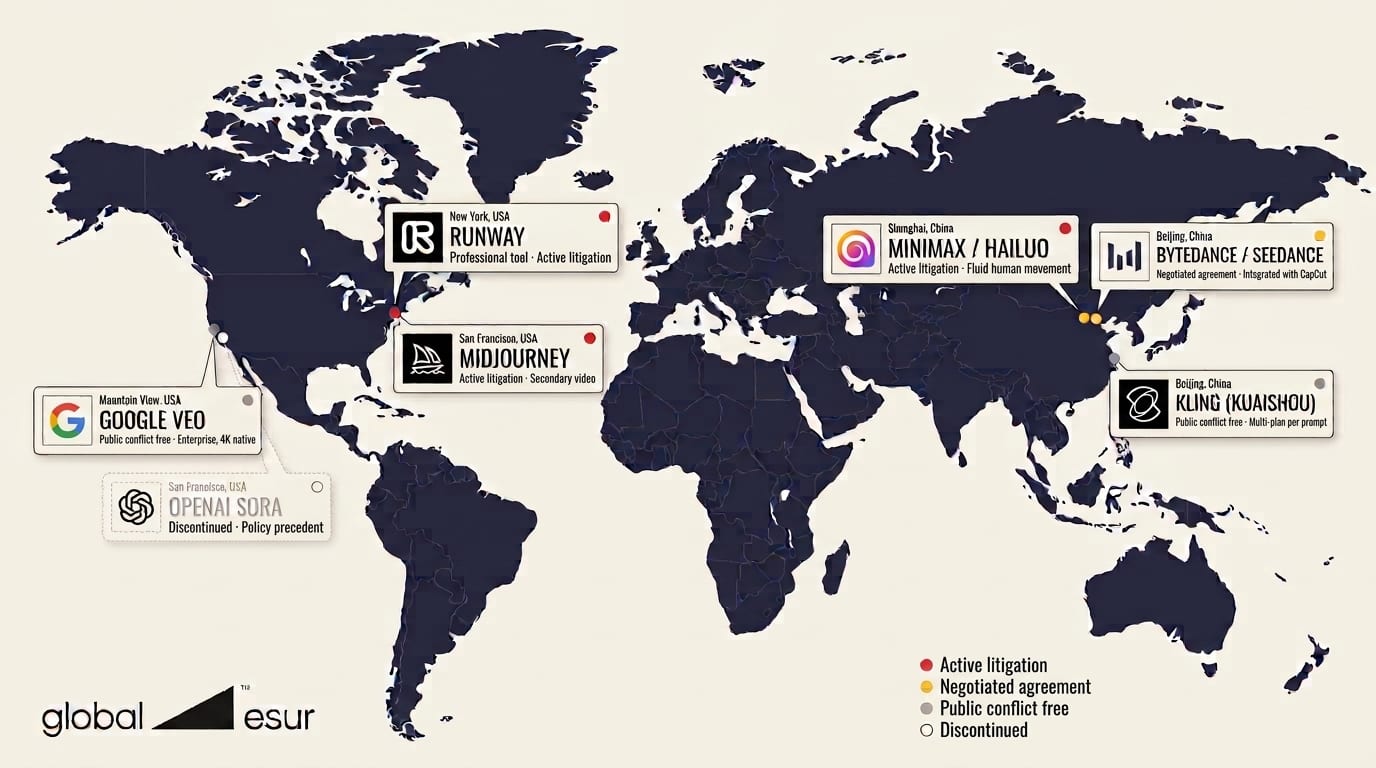
Runway
Its product is built for production teams, not casual exploration. The References system lets you upload several images of the same character and keep its appearance consistent across shots, something most of its competitors still handle poorly. It has the best-documented API in the space, which explains why studios and agencies pick it as a finishing tool rather than something to experiment with.
That professional positioning coexists with two active lawsuits, one from a group of visual artists and another over the origin of the YouTube videos used to train the model.
It brings in $300 million a year, but the most interesting thing about it lately is where the company is looking next. Runway just announced it's investing in world models, systems trained on video and sensor data to predict how an environment behaves physically, not to generate finished clips.
Here's the practical distinction. Generating a video for an ad campaign and teaching a robotic arm what happens when it drops an object in midair rely on the same underlying technology, the ability to predict motion over time. What changes is what that prediction gets used for. Runway is betting that the second market, robotics and physical simulation, will be worth more long term than continuing to go head-to-head on video generation for content creators. It hasn't left the video business, but it's the first sign that one of the six players on this map might be shifting its focus elsewhere.
MiniMax (Hailuo)
It markets itself with the line "a Hollywood studio in your pocket" and zeroes in on one specific thing: human movement. Videos generated with Hailuo show a fluidity in gestures and walking that other models still can't match, which made it a favorite among creator communities looking for fast, cheap results.
That same marketing line ("a Hollywood studio in your pocket") is what Disney, Universal, and Warner Bros. cite as evidence of intent in their lawsuit. The suit already cleared the motion-to-dismiss stage and is still ongoing, without slowing the pace of product launches or its Hong Kong IPO, where it debuted valued at $6.5 billion and topped $11 billion after its first day of trading.
Midjourney
It's still, above all, an image tool. Video only arrived last June as an added feature, not the core of the product, letting users turn a still image into short five-second clips, extendable up to twenty-one. Its revenue, estimated at $500 million, comes almost entirely from image subscriptions, so its place on this map has more to do with the legal weight it carries than its size in video. It's named in the same joint studio lawsuit, currently in discovery.
ByteDance (Seedance)
Unlike the others, Seedance doesn't exist as a standalone product. It's built into CapCut, Dreamina, and the rest of ByteDance's editing ecosystem. That gives it a distribution reach no competitor can match, even though there's no separate, publicly disclosed revenue figure for it.
After receiving a cease-and-desist letter from the Motion Picture Association in February, ByteDance signed a framework agreement in August that strengthens intellectual property protections around its video and image models. It's the first case of a video model developer reaching a negotiated protection framework with organized industry, without a court ruling forcing the issue.
Kling (Kuaishou)
It offers something distinctive: the ability to describe a multi-shot sequence in a single prompt and have the model keep continuity across shots, a storyboarding feature no other player on this list has pulled off with the same reliability.
That reliability comes at a cost. Demand has created infrastructure bottlenecks that user communities report regularly. It brings in roughly $240 million a year, has 60 million active creators, and is actively positioning itself to work with studios and agencies, with no known litigation against it.
Google (Veo)
It's betting on integration over virality. It offers the highest resolution in the group, with native 4K output, and lip-sync and dialogue quality that several independent comparisons rank above the rest. Access remains restricted at multiple levels, consistent with a product built for enterprise clients already using the rest of Google's ecosystem rather than individual creators. It has no litigation or public agreements, and builds its trust argument on corporate reputation rather than an explicit copyright policy.
Closing thoughts
Writing every week forces me to research, and as a result, to learn more about what's happening at the intersection of technology and copyright. If you go by what you see on social media, you'd think everything was already in place for one person and a computer to make a feature film at professional quality. The reality is different. We're still in the run-up to that.
Right now, I think the most practical uses are in advertising content and as a complementary tool during production. On this point, I trust that my readers know more about this than I do, and that you're already hearing about specific cases, or even applying it yourselves. As for me, I've opened up a new world, and I'll be keeping an eye on developments to keep bringing you these topics.